




DJs
Cafe 1001
Price N/A
Electronic Music
1 person interested

1 person interested
It is fitting that Brown Wimpenny, a folk collective who mine the transcendent collective power of traditional music to the deepest extent possible, should have emerged from the most informal - and social - of places.
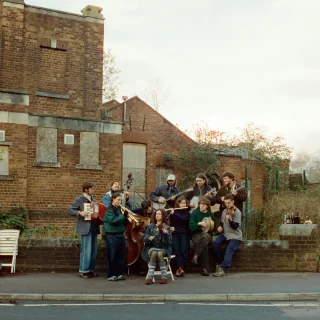
One Sunday in the spring of 2023, sisters Anna and Jess Korbel, tenor banjoist Seth Lockwood and mandolin player Archie Barker, met up in Lockwood's south Manchester living room to explore a collective budding interest in folk music. Then, the Sunday after that, they met again and once more the Sunday after that, attendance growing gradually each time. Before long it had sprawled into a weekly 25-strong get together and shared meal as much a jam session as it was a chance to eat, drink, relax and catch up together at the end of the working week.
The music they played was sprawling too like all the best sessions. It was expansive, chaotic and constantly shifting, and unlike a regular jam in more ways than one. By taking traditional songs as their starting point, which have no true owners other than humanity itself, there was genuine creative decentralisation, a true common understanding, as banjoist Luke Morris puts it. Because the songs come with their own rich histories and meanings, it allowed them to delve deep in search of those that would resonate with them the most an addictive process, says Lockwood and then to focus purely on the act of channelling them into the present, allowing those ancient energies to mingle with their own.
As Broadside Hacks, the powerhouse label and collective at the heart of Englands current folk resurgence, gear up to release Brown Wimpennys debut album, Long Live Brown Wimpenny, its worth pausing for a moment to take stock of just how magnificently that channelling is achieved. The northern industrial ballad Sheffield Grinder for instance, sees the intensely charismatic singing of accordion and musical saw player James Brown placed front and centre, skipping restlessly above a simmering bassline.
Its a song we found in Roy Palmers book Poverty Knock, says Brown. Its about how workers in poverty, especially northerners, are often blamed and shamed by the rich and powerful for struggling to look after themselves. It was written as a protest song in Sheffield in the mid-19th century, when the Knife Grinders, notoriously poor artisans, were being publicly and unfairly blamed by MPs for their use of child labour, lack of education, and toxic working conditions.
We wanted to do it because the north has a strong socialist folk history, and these important, rare songs are often underperformed, he continues. Heres its paired with a Morris tune, The Black Joak, to turn it into something danceable and channel the bitterness and resentment expressed in the song into something upbeat and radical. This is evident in the song choice for their upcoming album. As violinist Chris Bright says we found ourselves drawn to the human narratives that define traditional songs. Tales of hardened shepherdess and maligned steelworkers, lonely drunks and sailors nearing death. Its these stranger, often forgotten folk characters that really captured our imagination.
As those early sessions went on, Brown Wimpennys membership eventually whittled down from 25 to 15. Though it had begun as a social event, says double bassist Ted Downer-Wills, within a few months we were realising that itd be quite nice to put a gig on. The show was at Salfords tiny Henrykk bar and naturally sold out given that a quarter of the venues capacity was filled by the band themselves. It was chaotic, recalls Anna Korbel, none of us had any pickups, so there were so many microphones, but also joyous, with lyrics provided for their audience so that the boundaries between performers and audience could be deconstructed. It was an early indication of the way that communal energy and non-heirarchical structure present in those first informal meetups could be transferred to a live setting too.
The bands membership has now been concentrated further into a fixed lineup of 11 still a large number to navigate, not least given theyre based across three cities, Manchester, Liverpool and London. The way an idea is arranged at the beginning is often dictated by whos come to the rehearsal that week, says Downer-Wills. Its a point they use to their advantage, however; by letting the ever-shifting winds of practicality dictate their sound, Brown Wimpenny can maintain an edginess, a spryness, a lightness on their feet as they focus purely on the energy of the present.
Each iteration of a song is like a time capsule of that moment, adds flautist Ella Evans, in the same way that the people who performed the same songs centuries ago were providing time capsules of theirs, and how in 20 years, it will be different and reflect people then. Theres no ideology, no striving towards something that youre not just here I am, hanging out and making music.
Dont underestimate the importance of that last point. More than anything else, says Anna Korbel, we see the band as a shared social and creative endeavour. We love the sense of the everyday and the and the normal, and rejoicing in the collective and communal. I think that's the key to our process and our ethos. We're not over-egging anything. We're just seeing it and playing as it is.
Perhaps theres something to be said for the fact that the band was born in the north. Theyre not kitsch, they stress theirs is a multi-faceted and complex northernness but theres an undeniable sense of the regions identity rubbing off on them. Seeing the good in the grimness, finding it funny whilst also appreciating it, as Lockwood puts it. Like when you hear Blackpool organ music and see old dancehalls its not trendy, but it has a social utility. You get that all over the country, obviously, but theres definitely a northern flavour of that too, and I think there are elements of that that weve captured.
Their deep connection to their immediate surroundings is also drawn on in the choice of music they perform Sheffield Grinder, being the obvious example, given that the industrial history we exist around has a really strong presence in our work, as Korbel puts it as well as the way in which they perform it, the way collective energy bursts through the cracks in these tales of grinding routine. On a literal level, too, the band stress how much kinship they feel with the wider Manchester musical community the choirs that some of their members sing in, the public folk sessions theyve hosted and attended, the simple encouragement of friends. Its not just the 11 of us, its everybody whos ever been involved in our process and in our community, says Korbel, whove done us favours or have watched us. People always say that folk is the music of the people, but for us its not just the tunes that we play its the sense of togetherness, the public ownership of the music, everyone being together.
The sheer thrill of Brown Wimpennys music the connection to their surroundings, the constant push and pull between tradition and progression, the fraying at the edges, the shifts in direction is undeniable. And yet this focus on the everyday, the ordinary, is equally central. Its why the fact that they take their moniker directly from the unusual name of Lockwoods great great great great uncle, should be viewed as more than a mere curiosity.
The original Brown was a man from Linthwaite in West Yorkshire who grew up in the mid-1800s on a farm, then moved to Brooklyn to become a chauffeur, where he lived out the rest of his days. Id always heard this crazy name floating around in family stories, Lockwood says. They named the band after him initially as a fun nod to their personal past, but Browns since developed into something more than that - as well as a band mascot. Korbel, also an illustrator, has used the only surviving photograph they have of him as the basis for the bands visual identity across their gig posters and artwork. Its a nice memorial, like were keeping the name of this random relative alive, says Korbel, but theres also something about bringing the past forward into the future.
Hes almost taken on a life of his own as a sort of fictional character, who exists in our heads more than the guy he actually was, adds Morris. In other words, you might call him a folk hero albeit one whose life was distinctly un-heroic. By channelling their creative force into this everyman, the band have turned their namesake into a proxy for our entire shared humanity, a figure who symbolises the normal joys, hardships and mundanities we all experience can be found. Brown Wimpenny is anyone really he could be your mum, your dad, your mate, says Lockwood. The band have tried to capture this in their debut album. It does not mark the birth of something new, nor the culmination of efforts passed. It is simply a celebration of something that has always been in motion. Long Live Brown Wimpenny.
Bright highlights that The people and places through which we discovered this music are central to the choice of tracks on the album. From listening to source recordings of Frank Verrill and Jake Thackray during rehearsals, to picking up tunes at local pub sessions each track brings with it a little piece of the band's history. The music itself reflects the diversity of styles and influences within such a large band, and the spontaneous approach to arrangement they often take. Be it the punkish drive of Sheffield Grinder or the expansive soundscapes on Raglan Road, they filtered traditional songs through 11 different interpretations, altering their form to find their meaning.
The most powerful traditional music is the kind that reaches this core humanity, the joys, hardships and mundanities that remain consistent through time, even as the world around them changes. There are few who know that better than Brown Wimpenny.
Brown Wimpenny (Album Launch) took place on Friday 12 June 2026, 7:00 pm to 10:00 pm (London time).
Brown Wimpenny (Album Launch) was at MOTH Club, Valette St, London E9 6NU, United Kingdom.
Valette St, London E9 6NU, United Kingdom
Brown Wimpenny is an underground / emerging musical artist, but there is very limited publicly documented biographical information available in established music databases or press sources. At this level of visibility, artists are often active through small releases,…
1 other upcoming date listed on LINES in London.
MOTH Club is in East, London.
12 other events in London, 3 of them Ambient, on Fri 27 Nov 2026.
Brown Wimpenny (Album Launch) started at 7:00 pm and finished at 10:00 pm, London time.
Brown Wimpenny (Album Launch) was listed under Ambient, Experimental Electronic and Indie.
The lineup for Brown Wimpenny (Album Launch) lists Brown Wimpenny.